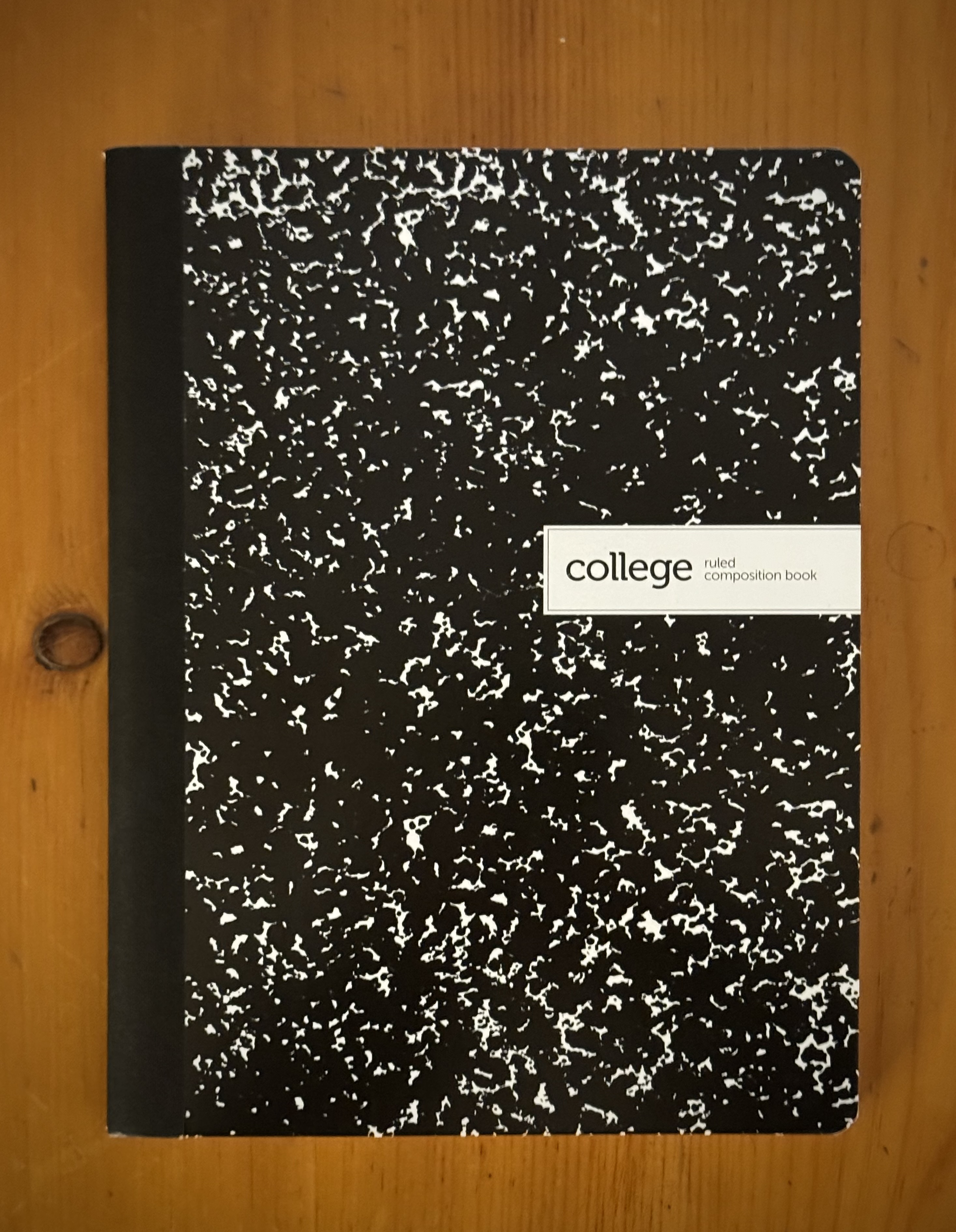
I have been keeping a journal for over fifty years now. I write first thing each morning while sitting in my recliner sipping tea and eating an English muffin. The view from my chair changes with the seasons. What I see right now are trees and sky–evergreens and bare deciduous trees surrounding the wetland below the bluff where my house sits. I love this view, love watching the changes in the trees and light as each season gradually moves into the next, winter giving into spring, which in turn will yield to summer, then autumn before returning to winter again. Douglas firs, cedars, alders–a classic Pacific Northwest landscape.
I began journal writing in a very different landscape. I was a student at Arizona State University, and the trees around me were palm trees, mesquite and palo verde. I was an English major, and the teacher in one of my writing classes had us keep a writers’ journal, much like an artists’ sketchbook. We were to write at least two entries a week in which we described something that caught our attention, including our thoughts about it. I found I loved doing that writing, found it satisfying, and kept it up intermittently throughout college. When I began teaching high school English, I had my students keep a similar journal, one they wrote in for the first ten minutes of each class. I also wrote during those ten minutes, and gradually journal writing became a daily practice, one that anchored my days and helped me navigate the often-painful task of learning how to teach.
Writing down thoughts, feelings and questions helped me see them in a way that I could not when kept inside my mind. Those thoughts and feelings no longer went round and round over and over again and again. Seeing them in writing on paper brought insight that allowed forward movement, allowed me to see actions I could take and gave me a new understanding of my situation.
The journal was now a friend, my companion. It was a place where I could say all the things that felt too private to share with other people. And answers to questions about life that had long bothered me began to emerge. It began to feel like I was in dialogue with Life itself, with the more-than-self. My journal felt like prayer. The writing was not pious. It was not addressed to God. I was agnostic when I started keeping a journal and that had not changed. But what it did do was to gradually open up the whole issue of religious faith, made me look at it again and take seriously the possibility that underneath religious traditions there might be genuine insights into reality itself. Pursuing that possibility eventually took me to The Graduate Theological Union in Berkeley, California, a journey I wrote about in the final book of my family heritage trilogy.
The sense of my journal as prayer is still with me. The dialogue with Life continues. I still feel response to my questions and requests for insight and guidance. Like devout Jews I am deeply reluctant to use the word God. But what that word seeks to express lies at the heart of the faith, the vision that grounds my life.
 Heritage